The brief
I built Monday as a sample for my portfolio. The learner I had in mind is a new team lead. The skill it practises is prioritizing under pressure: telling what is urgent from what is only loud.
I wanted to show adaptive, data-driven learning design. The activity responds to what the learner does, and it shows them a picture of it.
The problem it solves
I used action mapping, Cathy Moore's method of starting from the problem instead of the content. The goal, for a fictional company, is that new team leads keep small problems from growing into escalations during their first 90 days. The measure is how many high-stakes messages get handled in time.
From that goal I listed what a new lead has to do on the job: judge a message by what is at stake and when it is due, notice the quiet message that matters, delegate what a teammate can do well, face the hard items instead of putting them off, and triage fast in a crisis. The habits the debrief looks for are the opposite of those behaviours.
The cause is mostly the environment, not missing knowledge. An inbox pushes signals like rank, recency, and ease. So the activity is practice in that environment, with a short triage guide a learner can open as a job aid, not a lecture first.
How it works
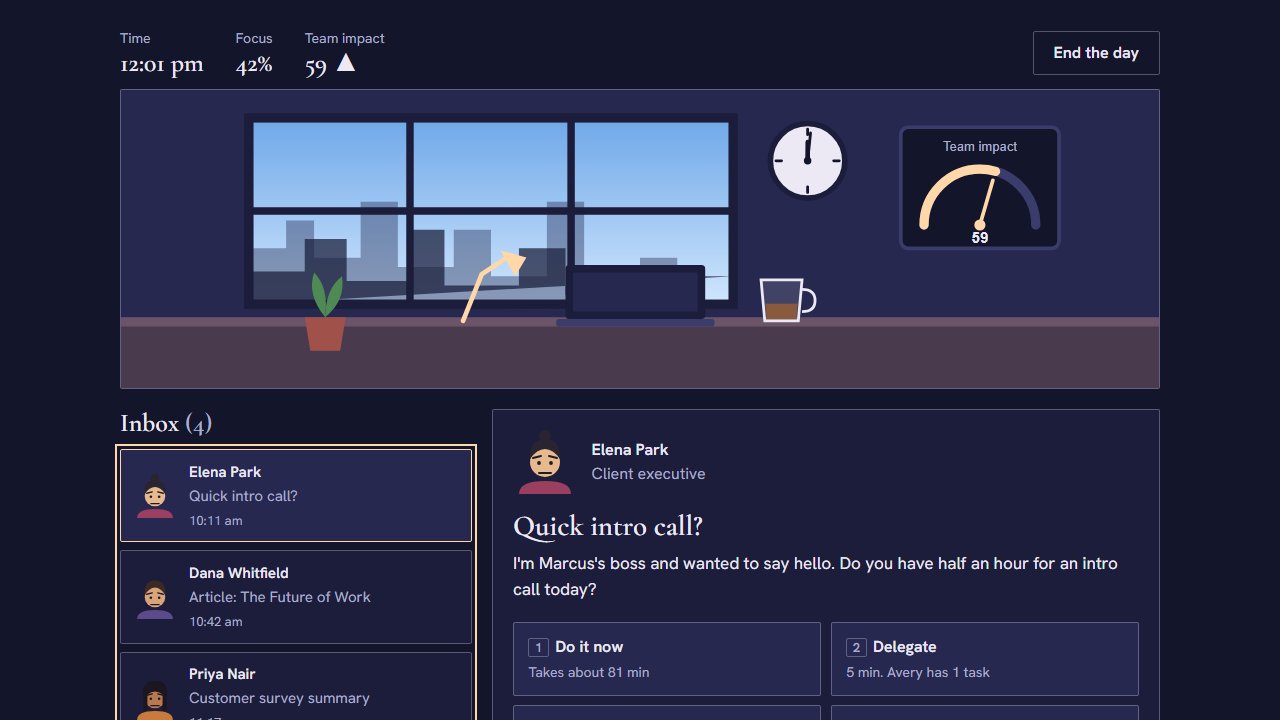
A short story frames the day. The learner is a new team lead on a first Monday, and their old boss, now a vice president, is watching. The learner spends one simulated workday, 9:00 to 5:00, in an illustrated office. Messages arrive in the inbox. For most messages the learner chooses to do it now, delegate it, schedule it, decline it, or send a quick holding reply that buys a little time. Twelve key messages instead offer four specific responses, each one something a real lead might do, and each wrong answer is tempting because it matches a real habit, like jumping for a senior sender or putting off a hard item. Time passes only when they act, and every action costs minutes and focus.
A team impact meter on the office wall moves after every decision. Some consequences arrive hours later, so a choice that looked fine at 10:00 can cost points at 3:00. Nothing is graded, and no message is labelled right or wrong.
Once a day, at a random time, a crisis breaks: four connected messages arrive within minutes, from different people with competing deadlines. There are three possible crises, matched in difficulty, and which one happens is chosen by chance. The debrief scores the crisis separately, so the learner can see whether they improve under pressure.
At 5:00 the day rewinds into a debrief: a note from the old boss, the real measure first (how many high-stakes messages were handled in time, and how many problems escalated), a priority matrix of every decision, what a strong response looked like on each key message, a table of the day in order, a short note on any habit that showed up, and a review of the crisis. It ends by asking the learner to choose one habit and write what they will do differently on a real Monday, and the next attempt checks how that habit changed.
What adapts
Three things adapt. Within a day, a message that is ignored can come back as something worse. Between days, the replay is built from a larger pool of messages and leans toward the habit the learner showed last time, at about the same overall difficulty. Over time, a judgment index and a trend line show whether the learner is improving or slipping.
The debrief looks for five habits: favouring rank over impact, favouring quick wins, handling the newest message first, putting off hard items, and delegating work that needs the lead.
The adaptivity is rule-based. There is no machine learning, so every note in the debrief can be traced back to the learner's own choices. Results are saved only in the learner's own browser.
The process
I built Monday with Claude Code. I decided what the piece had to prove and which skill to practise, chose the visual direction, and asked for the running meter. The work ran in this order:
- Decide what the piece should prove, and name the problem and the behaviours that solve it
- Write the design and the build plan
- Build and test the scoring and adaptive logic
- Tune the scoring against two scripted players, one thoughtful and one reactive
- Build the office scene, the inbox, and the debrief
- Check it by keyboard and on a phone
No one has played it yet, so it has not been tested with real learners.
The build
Monday is plain HTML, CSS, and JavaScript. There is no framework, no authoring tool, and no server. The office scene and the characters are drawn in code, and the light in the window follows the simulated clock. The logic is kept separate from the screen and is covered by automated tests.
The hardest part
Getting the balance between adaptivity and feedback right. The learner needs to see that their choices matter without being told the answer, and the meter and the debrief have to show progress or slipping without turning the day into a quiz.