The brief
I built Financial Literacy as a sample course. The learner I had in mind is a young person who is unfamiliar with finance and needs guidance on managing money and making sound investments.
The problem is a lack of knowledge about financial concepts and how to apply them. I set the objectives myself. The approach is fairly academic, which suits a course whose main goal is the transfer of knowledge, though it also teaches some practical skills.
The two pieces here make up the first module. The full course is larger.
Where the content came from
Subject-matter experts supplied the basic material and gave feedback on how it should be structured. I used AI to help me carry out the changes needed to make that material ready for learners.
Two parts, two jobs
Part 1.1, Defining Financial Literacy, does the conceptual heavy lifting. It gives the learner the background they need for what comes next.
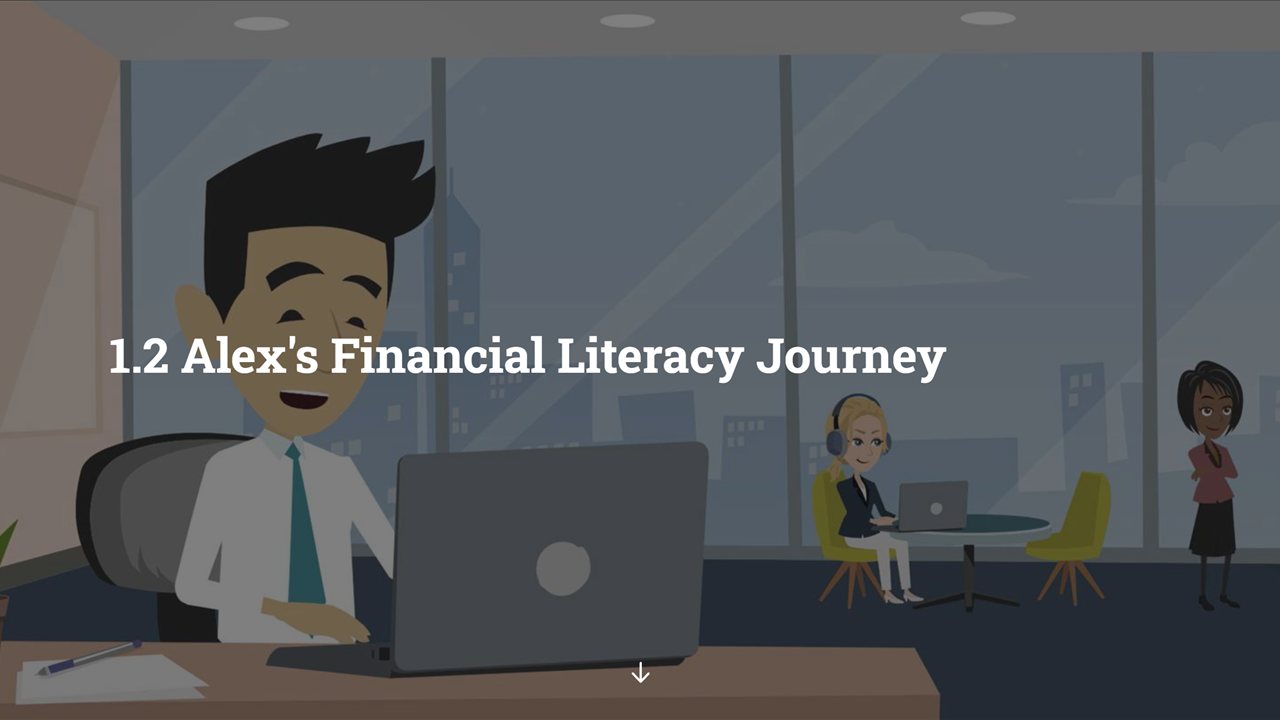
Part 1.2, Alex's Financial Literacy Journey, is a scenario. Alex is a young person who has never made an investment. A coworker recommends one and offers him a chance to make money. Alex has to decide what to do, and so does the learner.
I used a story to create interest and engagement. I did not follow a particular method. I wanted realistic, relatable scenarios that address a real problem.
How it works
Across the course, learners read, watch videos, answer knowledge checks, and work through scenarios. In Alex's journey the learner chooses how the story proceeds.
Nothing is scored or tracked. The course is practice, not a test.
The process
I worked alone, and the two parts took about 35 hours. The work ran in this order:
- A script for 1.1, written from the experts' notes, with its content and design
- A storyboard and script for 1.2
- The build
- Review by an outside auditor, with feedback
The auditor reviewed the work after the build was finished, so their feedback arrived on a finished product.
The build
Both parts are built in Rise 360. The scenario is the only non-standard block, and it takes three tools to make.
I create the video segments in Vyond, the animation platform. I then place them in a branching scenario in Storyline, where learners choose how the story proceeds. The finished scenario goes into the Rise lesson.
The characters are all native Vyond characters, and the voices were made with WellSaid Labs voice-generation software.
Some scenarios in later modules get quite complicated. Their options have different effects depending on what the learner chose earlier.
The hardest part
Getting Vyond and Storyline to work together. It was the most challenging part of the build, and well worth the effort.